













































According to the Stack Overflow Developer Survey 2025, Angular holds 18.2% market share among developers — third behind React.js and Vue.js — but its adoption is disproportionately concentrated in enterprise, government, banking, and healthcare sectors. These industries need scalable, high-performance web applications that hold up under regulatory requirements and complex business logic.
Because Angular is often used for business-critical systems, experienced developers are harder to find than the framework’s popularity might suggest. Many candidates have worked with Angular, but far fewer have built and maintained large production applications with it.
If you’re a startup or SMB looking to hire Angular developers, this guide covers what the role demands, what strong candidates look like, and how to get from decision to productive work without months of interviewing.
AngularJS vs Angular: Know the Difference Before Hiring
Many companies searching for AngularJS developers don’t realize they’re looking at two fundamentally different products. AngularJS is the legacy 1.x JavaScript framework, largely unmaintained since 2022.
Modern Angular (versions 2 and above) is a complete rewrite built on TypeScript, with a different architecture, tooling, and hiring bar. A developer whose experience is primarily AngularJS will need significant ramp-up time on a modern Angular framework project. When you post a role or brief a hiring platform, specify which one you need. In almost every case in 2026, the answer is modern Angular.
What to Look for When You Hire Angular Developers
Startup founders and CTOs at SMBs post job descriptions stuffed with every Angular-adjacent keyword they can find, and end up with candidates who check boxes but can’t build anything production-ready.
When evaluating Angular developers, focus on the skills that have the biggest impact on scalability, performance, and long-term application maintainability.
Angular Architecture and Framework Fundamentals
A developer should be comfortable working with Angular’s component-based architecture, including components, directives, pipes, services, dependency injection, routing, and lazy-loaded modules. These fundamentals determine whether an Angular application remains maintainable as new features, developers, and business requirements are added over time.
A strong candidate should be able to explain how Angular handles rendering, change detection, and component lifecycles, or how architectural decisions made today will affect the codebase a year from now.
TypeScript and JavaScript Expertise
Strong Angular developers go well beyond basic syntax. Look for experience with generics, utility types, advanced typing patterns, interface design, and type-safe API integrations.
Developers with solid TypeScript and JavaScript skills tend to produce cleaner code, make fewer runtime errors, and build more scalable web applications. They also simplify onboarding, as their code is easier for the rest of the development team to understand and extend.
RxJS and State Management
Modern Angular applications rely heavily on reactive programming to manage real-time data, asynchronous workflows, and user interactions. Candidates should understand observables, error handling, memory leak prevention, and state management approaches such as NgRx.
Poor RxJS decisions rarely cause immediate problems. But they slowly create performance bottlenecks, debugging headaches, and unpredictable behavior as Angular projects become more complex.
API Integration and Data Layer Design
A strong developer should know how to connect the front end to APIs, manage user authentication, handle data efficiently, and keep information synchronized across the application. Whether users are tracking deliveries in real time, collaborating with teammates, or accessing sensitive business data, the experience should feel seamless and reliable.
Front-End Performance and User Experience
Look for practical experience with performance optimization techniques such as lazy loading. Senior developers should be able to explain how they identify bottlenecks and improve responsiveness in large Angular applications.
These skills become important when building single-page applications (SPAs), progressive web apps (PWAs), e-commerce platforms, and other high-performance web applications where every second of delay affects user satisfaction and conversion rates.
Strong candidates also pay attention to accessibility, responsive design, and the small UX design details that make user interfaces feel polished.
Testing and Code Quality
Experienced Angular developers know when a unit testing approach is sufficient and when integration or end-to-end testing provides better protection. Familiarity with Jasmine, Karma, debugging tools, and modern testing workflows is essential.
HTML, CSS, and UI Development
Candidates should be comfortable building user-friendly interfaces using semantic HTML, CSS, SCSS, Tailwind CSS, and reusable component libraries. This becomes especially important when creating design systems or maintaining large Angular applications across multiple teams.
Angular CLI and Angular Material
These tools won’t determine whether a developer succeeds, but they significantly affect productivity and workflow efficiency.
Angular CLI is far more than a code generator. Experienced developers use it to manage project structure, build configurations, environments, custom schematics, and deployment preparation.
Angular Material is equally common in production Angular projects. Familiarity with its open-source component library helps developers build accessible, consistent user interfaces faster without reinventing common design patterns from scratch.
Deployment and Delivery Workflows
Modern Angular developers are often expected to participate in shipping and operating applications, rather than just building them.
Experience with GitHub, GitHub Actions, Docker, CI/CD pipelines, AWS, GCP, or Vercel can significantly reduce friction between development and release. Developers who understand deployment workflows tend to collaborate more effectively with backend, DevOps, and project management teams.
Server-Side Rendering and SEO
Not every Angular application requires server-side rendering, but for SEO or initial load performance, this expertise becomes valuable.
Look for experience with Angular Universal, hydration strategies, and search engine optimization techniques. These skills are relevant for marketplaces, content-heavy websites, public-facing SaaS products, and e-commerce businesses.
AI-Assisted Development and Full-Stack Awareness
Most experienced programmers use tools such as GitHub Copilot, Cursor, or Claude Code as part of their software development workflow. The core value is in the developer’s capability to review, validate, and integrate AI-generated output responsibly.
Cost to Hire an Angular Developer
Pricing for Angular talent varies significantly based on experience level, location, engagement model, and whether you’re hiring individual developers or broader Angular development services. Here’s what the data shows from the Lemon.io 2026 Angular salary report.
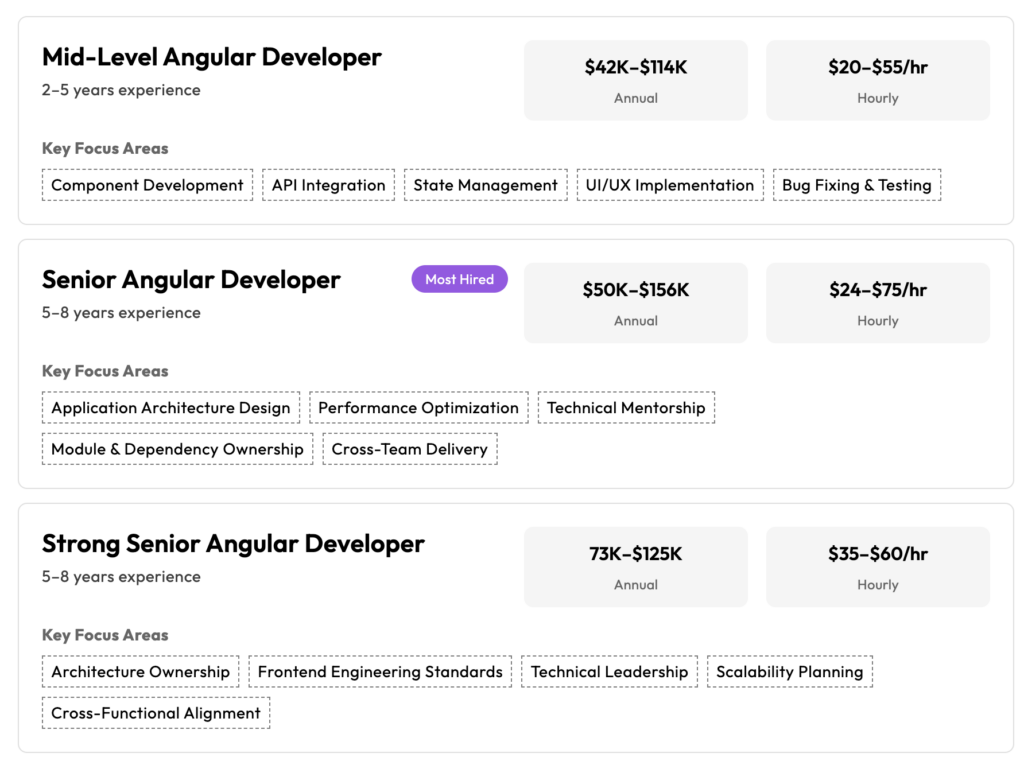
Lemon.io Angular rates statistics
US salary benchmarks
For full-time, in-house Angular developers in the United States:
- Junior (1-3 years of experience): $76,000–$89,000/year according to ZipRecruiter and Glassdoor
- Mid-level: $108,000–$131,000/year, with the average sitting around $121,649
- Senior (8+ years): $134,000–$190,000/year, with Glassdoor reporting an average of $150,285
When you factor in benefits, recruiting fees (typically 15-25% of first-year salary), onboarding costs, and the 3-6 weeks it takes to fill a role through traditional hiring, the true cost of an in-house Angular developer hire is 30-40% above the base salary.
How Quickly Can You Hire with Lemon.io?
Hiring Angular developers doesn’t have to become a months-long project. Lemon.io helps companies connect with high-quality, vetted developers whose technical skills, programming language expertise, and experience match their business needs.
Every candidate is pre-screened for various skill sets: communication, problem-solving ability, and real-world software development experience, allowing you to spend less time sourcing and more time evaluating fit. Most clients receive relevant matches within 24–48 business hours and begin interviews shortly afterward.
Check out a detailed list of technical interview questions we commonly ask Angular candidates.
Matching process
Our process is human-led: you describe project requirements, tech stack, team structure, and timeline. Within 24 hours, we provide you with CVs of hand-picked candidates from our database of vetted developers.
Our Angular developers work with the modern tech stack: Supabase, Vercel, Tailwind CSS, Prisma, Docker, GitHub Actions, and more. They’re also fluent in AI-augmented development workflows to ship faster without sacrificing code quality.
Before any Angular developer joins our marketplace, they go through a multi-stage vetting process that tests real-world capability. We evaluate their TypeScript proficiency, understanding of RxJS and state management, and ability to architect maintainable applications. Only about 4% of applicants make it through.
From match to productive work in one week
With a vetted developer who’s experienced with modern Angular and your adjacent stack (Node.js, AWS, Docker, etc.), you can realistically expect productive output within the first week. Compare that to the typical in-house hiring process timeline:
- Writing and posting the job description: 1 week
- Collecting and screening applications: 2-3 weeks
- Technical interviews: 1-2 weeks
- Offer negotiation and notice period: 2-4 weeks
- Onboarding: 1-2 weeks
That’s 7-12 weeks from decision to productivity. With Lemon.io, it’s days. We show you the candidates, you interview your favorites, and start working together. Our developers work across time zones that overlap with US and European business hours.
Stop sorting through resumes and start building — hire Angular developers through Lemon.io and get matched with vetted, dedicated front-end developers in under 24 hours.
Lemon.io is a marketplace for hiring vetted senior developers with 3+ years of commercial experience. We vet technical expertise and real-world Angular experience upfront, leaving you with one interview to evaluate team fit. If the first match doesn’t work out, Lemon.io replaces the developer at no extra cost.